
Introduction
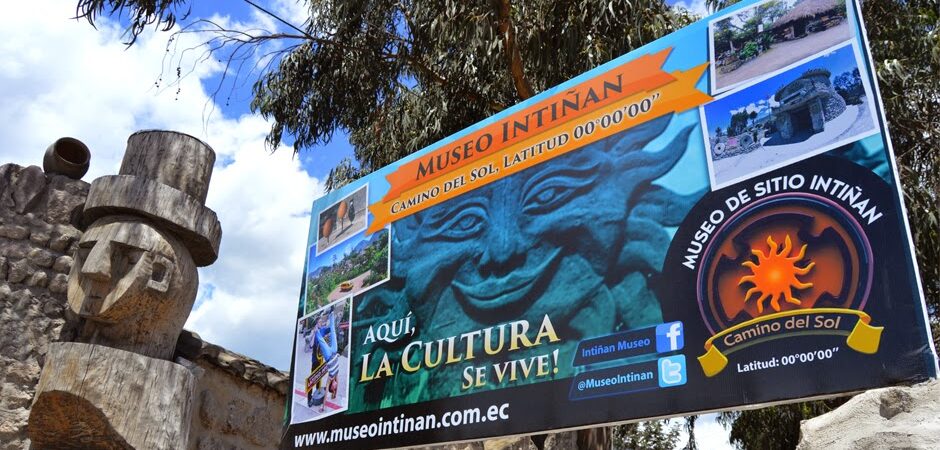
Not far from Quito, next to the well-known tourist area of Mitad del Mundo, you will find the Intiñan Museum, one of the most visited and talked-about places related to the Equator line in Ecuador. Tourists come here not only to take a photo at latitude 0°, but also to enjoy a more direct and interactive experience: demonstrations, explanations about Indigenous peoples, traditional houses, solar symbols, and a special atmosphere where geography becomes part of the journey.
Intiñan is often known as the museum of the “true Equator line.” The large Mitad del Mundo monument was built according to historical measurements related to the geodetic studies of the past. Later, modern navigation methods showed that the 0° latitude line passes a little farther north of the monument. That is why the Intiñan Museum became a very popular alternative: it offers visitors a closer, more practical, and more interactive way to learn about the Earth’s Equator.
But the main value of Intiñan is not only in the debate about where the “true line” exactly passes. The meaning of the museum is broader: it helps visitors understand why the Equator was important for ancient peoples, how they observed the sun, how geography influences culture, and why Ecuador received its name from this line that divides the Earth into the Northern Hemisphere and the Southern Hemisphere.
What does the name Intiñan mean?
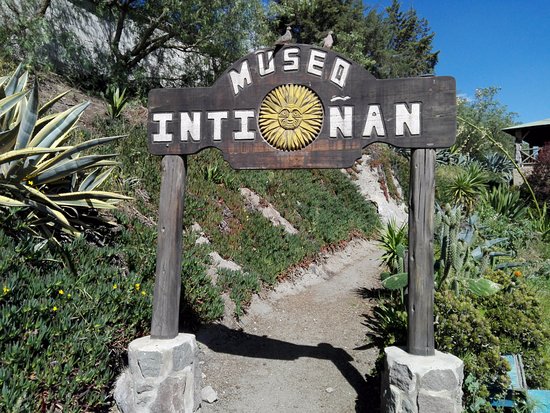
The name Intiñan is usually explained through the Kichwa language: Inti means “sun” and Ñan means “path” or “trail.” That is why Intiñan can be translated as “Path of the Sun.” For the museum, this name has strong symbolic value. It is not only related to the Equator line, but also to the ancestral observation of the sun’s movement, calendars, agriculture, and the idea of harmony between human beings and nature.
In the area of Quito and Mitad del Mundo, the subject of the sun has a special meaning. On the Equator, the sun behaves differently than it does in countries located far to the north or far to the south. During the equinoxes, the shadow can become very short, and the idea of being in the “middle of the world” takes on not only a geographical meaning, but also a cultural one.
Why are there two “Equator lines” near Quito?
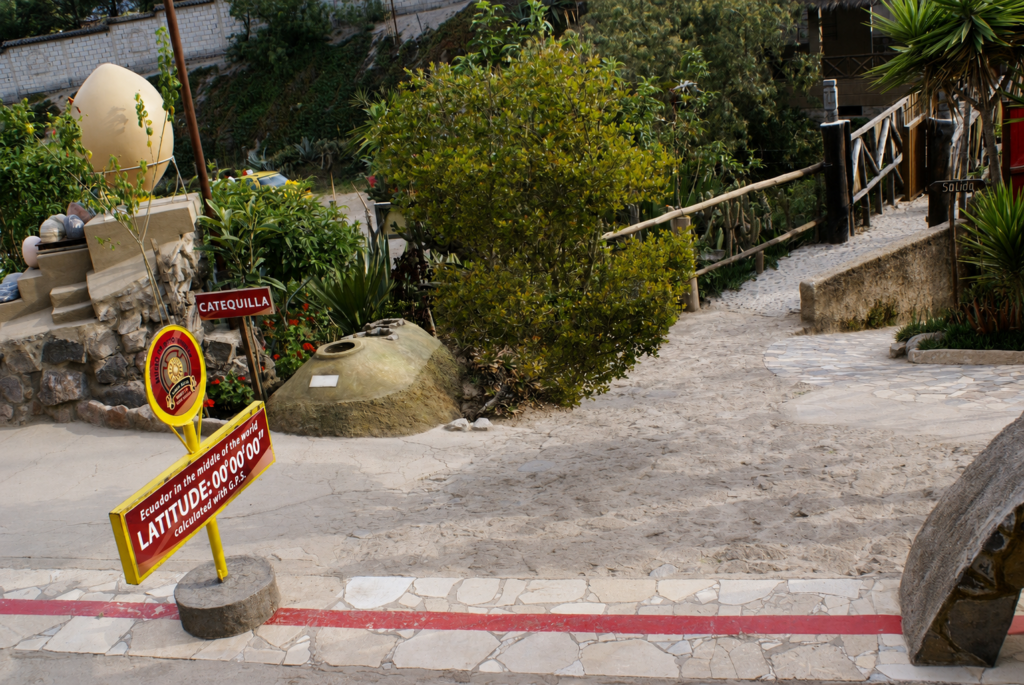
Many tourists are surprised to discover that there is the large Mitad del Mundo monument and, separately, the Intiñan Museum, which also talks about the Equator line. To understand this, it is necessary to separate two things: historical value and modern precision.
The Mitad del Mundo monument is connected to the historical tradition of measuring the Earth. In the 18th century, the French Geodesic Mission carried out very important measurements in this part of the world, helping to confirm the shape of the planet. For its time, that work was very precise and had enormous scientific value. Later, based on that tradition, the famous tourist symbol we now know as Ciudad Mitad del Mundo was created.
But modern technologies, including satellite navigation, made it possible to measure coordinates more accurately. That is why information appeared showing that the real 0° latitude line does not pass exactly through the center of the monument, but a little farther away. Much of Intiñan’s popularity is based on this idea: the museum offers tourists an experience related to the Equator line measured with modern methods.
However, it is better not to turn this into a simple comparison of “one is correct and the other is incorrect.” Mitad del Mundo is the great historical and symbolic center of the Equator theme. Intiñan is a more interactive place, where visitors approach the Equator through experiences, demonstrations, and cultural stories. It is best to see them as two different but complementary places.
The main idea of the museum
Intiñan is not a classic museum where visitors simply walk from display case to display case. It is more like an open-air museum with several areas where topics related to geography, astronomy, culture, and the everyday life of the peoples of Ecuador are explained.
The essence of the museum can be summarized as follows: to show that the Equator is not just a line on the map. It is a place where science, mythology, sun observation, traditions, rural life, the history of Indigenous peoples, and the traveler’s curiosity all come together.
That is why Intiñan can be interesting for different types of visitors. For some, it is a place to take good photos. For others, it is an interactive geography lesson. For others, it is an opportunity to see elements of traditional Ecuadorian culture. And for those who have already visited the main Mitad del Mundo monument, the museum helps complete the experience in a more lively and direct way.
What can you see at Intiñan?
The museum usually presents several themed areas. The first is the Equator line itself, where tourists take photos with one foot in the Northern Hemisphere and the other in the Southern Hemisphere. This is the most recognizable part of the visit.
The second area is dedicated to interactive demonstrations. There, visitors can see experiments with water, balance, an egg on a nail, and body orientation on the Equator line. These demonstrations often make people smile, feel surprised, and want to record short videos.
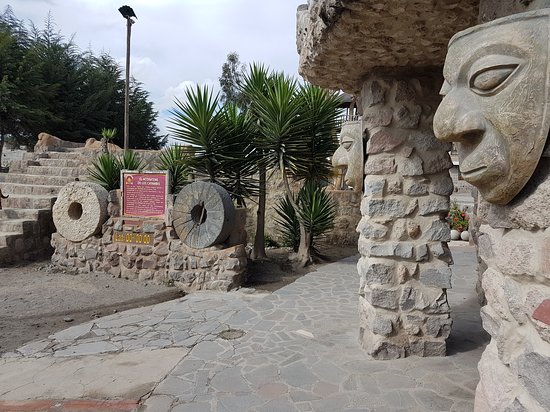
The third part is cultural. In the museum, visitors can see elements of traditional houses, everyday objects, reconstructions, and explanations about the Indigenous peoples of Ecuador and their relationship with nature, the sun, and the land. This part is what makes Intiñan more than just a “place for photos”: it turns it into a small story about the country.
You can also find symbolic objects, totems, solar signs, and exhibitions related to the worldview of the peoples who lived in the equatorial region. For tourists, it is a quick way to get a general impression of Ecuador’s cultural diversity.
Interactive experiences: what you should understand
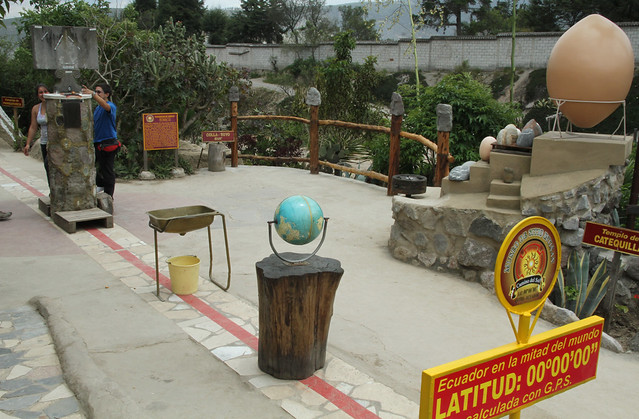
The most famous part of Intiñan is the demonstrations related to the Equator line. Visitors are shown how water appears to spin in different directions on each side of the line, how they can try to balance an egg on a nail, how it becomes more difficult to walk with your eyes closed along the Equator line, or how the sense of balance seems to change.
These demonstrations make the visit very entertaining and create the feeling of being in a special place. But it is worth saying honestly: some of these experiences should be understood more as tourist and educational demonstrations than as strict scientific experiments.
For example, the Coriolis effect really exists and influences large atmospheric and oceanic processes. But in a small container of water, the direction of the spin can depend on the shape of the container, the way the water is poured, the movement of the hands, and other factors. That is why the water demonstration is more useful for explaining an idea than for proving it in a strict laboratory sense.
The same happens with the egg on the nail. At the Equator, there are small particularities related to the Earth’s rotation and the shape of the planet, but balancing an egg on a nail is not something exclusive to the Equator line. Patience, the shape of the egg, and the precision of the person trying it also play a role. Even so, for tourists it is a memorable moment, because it turns an abstract idea of geography into a personal experience.
This is how Intiñan should be understood: not as a strict scientific laboratory, but as an interesting, interactive, and cultural place where complex topics are explained in a simple and accessible way.
The cultural part of the museum
The special value of the museum is not only in the Equator line, but also in its cultural context. Intiñan talks about the peoples who lived in this area long before modern tourism and satellite navigation. For them, the sun, the shadow, the seasons, the mountains, and the direction of light were not abstract concepts, but part of everyday life.
Traditional houses and everyday objects help show how people built their homes, used natural materials, prepared food, stored their belongings, and adapted to the climate. These exhibitions are especially important for tourists who do not want to see only beautiful landscapes, but also understand how people lived in different regions of Ecuador.
The museum also includes references to Amazonian cultures, symbols, totems, and traditions. These topics should be viewed with respect: they are not simply “exotic things,” but part of the country’s cultural memory. In this way, the Intiñan Museum helps connect geography with culture.
How is Intiñan different from Mitad del Mundo?
Mitad del Mundo and Intiñan are often compared, but they have different formats. Mitad del Mundo is a large, recognizable, and symbolic complex, with a monument, museums, souvenir shops, restaurants, and broader tourist infrastructure. It is a place with a more official and monumental image.
Intiñan, on the other hand, is smaller, more intimate, and more participatory. It does not impress so much because of its size, but because of the way it involves the visitor. There, tourists do not only observe: they listen to the guide, try to walk along the line, take photos, watch demonstrations, and ask questions.
If travelers have enough time, it can be a good idea to visit both places. Mitad del Mundo offers the classic photo and the feeling of standing in front of one of Ecuador’s most famous attractions. Intiñan adds interaction, details, culture, and a conversation about the modern 0° latitude line. Together, both places can offer a more complete experience of this area near Quito.
Interesting facts about the Intiñan Museum
The first interesting fact is that the name of the museum is related to the sun. This reflects the meaning of the place very well, because the Equator is not only a geographical line, but also an area where solar observation was very important for ancient calendars and agriculture.
The second fact is that many tourists see Intiñan as the “true Equator.” However, it is more accurate to say that the museum is located in the area of the modern 0° latitude line and uses this topic as the basis for an interactive experience. Even if the exact precision of a specific marker is debated, the place is still very close to the Equator and has great value for the tourist experience.
The third fact is that many of the museum’s demonstrations work more as a way to spark interest in geography than as scientific proof. They are like a small educational performance: simple actions that help visitors remember complex concepts.
The fourth fact is that the museum is very close to Mitad del Mundo, so it can easily be included in the same visit, depending on the traveler’s time, pace, and interests. This can be convenient for tourists who want to see more than one place during the same outing.
The fifth fact is that Intiñan works very well for short videos and Shorts-style content. It has many visual moments: the Equator line, the demonstrations, the traditional houses, the solar symbols, the guide, and the direct interaction with visitors.
How to make the most of your visit to the museum
It is best to visit the Intiñan Museum without rushing. Although the museum can be explored relatively quickly, the experience will be better if you leave time for the guide’s explanation, questions, photos, and a calm visit to the cultural area.
A visit to the Intiñan Museum can be combined with other places near the Mitad del Mundo area, but there is no single correct way to organize the visit. It all depends on the time available, the pace of each traveler, and the type of experience they are looking for.
Some tourists prefer to spend more time at the Mitad del Mundo complex and explore it calmly. Others also want to visit the Intiñan Museum, the Pululahua crater, or other sites related to the Equator line, always according to their interests and without turning the visit into a rushed route.
There is also another place linked to solar observation and the Equator line: Cerro de Catequilla. It is not always included in classic tourist visits, but it can be interesting for those who want to explore more deeply the history, ancestral astronomy, and the relationship between ancient peoples and the Earth’s Equator.
That is why the most appropriate approach is to organize the visit in a personalized way. Some travelers walk quickly and prefer to see several places; others enjoy a calmer visit, with pauses, photos, and explanations. At Bernabé Travel Latam, visits are prepared according to each person, not as a fixed route that is the same for everyone.
Clothing should be comfortable. Since the museum is partly outdoors, it is a good idea to bring a light jacket, a cap or sun protection, and comfortable shoes. Although it is close to Quito, the weather can change quickly: sun, wind, clouds, and cold can alternate during the same visit.
Who will especially enjoy Intiñan?
The museum is a good option for tourists who do not like only to look, but also to participate. If someone is interested in interactive places, short explanations, a dynamic guide, and curious facts, Intiñan usually leaves a good impression.
It is also recommended for families, because children and teenagers often find it easier to understand geography through experiences rather than long explanations. But the museum is also interesting for adults: it has historical context, cultural exhibitions, and the possibility of comparing the symbolic Mitad del Mundo with a more practical and participatory format.
Conclusion
The Intiñan Museum is one of the most interesting places near Quito for those who want to experience the Equator in a clear and direct way. Here, the 0° latitude line stops being an abstract coordinate and becomes a personal experience: visitors stand on the line, take part in demonstrations, listen to the history, and observe elements of the culture of the peoples of Ecuador.
The main strength of Intiñan lies in combining simplicity and meaning. The museum does not overwhelm visitors with complicated theory, but it helps them understand that the Equator is not only geography. It is also sun, land, traditions, scientific measurements, tourism debates, ancient observations, and the modern human desire to understand our place on the planet.
If you are planning a visit to the Intiñan Museum, Mitad del Mundo, or other places near Quito, the best option is to organize it according to your time, your pace, and your interests. There is no fixed route that is the same for everyone: some travelers prefer to visit fewer places calmly, while others want to explore more sites related to the Equator line, such as the Pululahua crater or Cerro de Catequilla.
At Bernabé Travel Latam, we can help you prepare a personalized visit, with accompaniment and practical recommendations to make the experience more comfortable, interesting, and safe. You can check our tours in Ecuador y escribirnos para organizar el recorrido según lo que realmente quieras conocer. Vea nuestro contacto y comunique con nosotros.
Leave a Reply